To optimise for Google AI Overviews in 2026, structure your content with direct answers first, build clear entity signals via Organisation and Person schema, write self-contained passages AI can extract, ensure technical health through Core Web Vitals and indexability, and establish author credibility through named credentialed authorship.
If your organic traffic has changed over the past year even though your Google rankings have remained relatively stable, you are not alone. The way people discover information through search is changing rapidly.
Google AI Overviews can now provide direct, AI-generated answers for many informational and research-oriented searches. This changes the traditional search journey. Instead of clicking through several blue links, users may get an answer directly within the search results.
For businesses, the goal is no longer simply to rank for a keyword. Your content also needs to be clear, useful, trustworthy, technically accessible, and easy for AI systems to understand and cite.
That is where Answer Engine Optimization (AEO) and Generative Engine Optimization (GEO) become important.
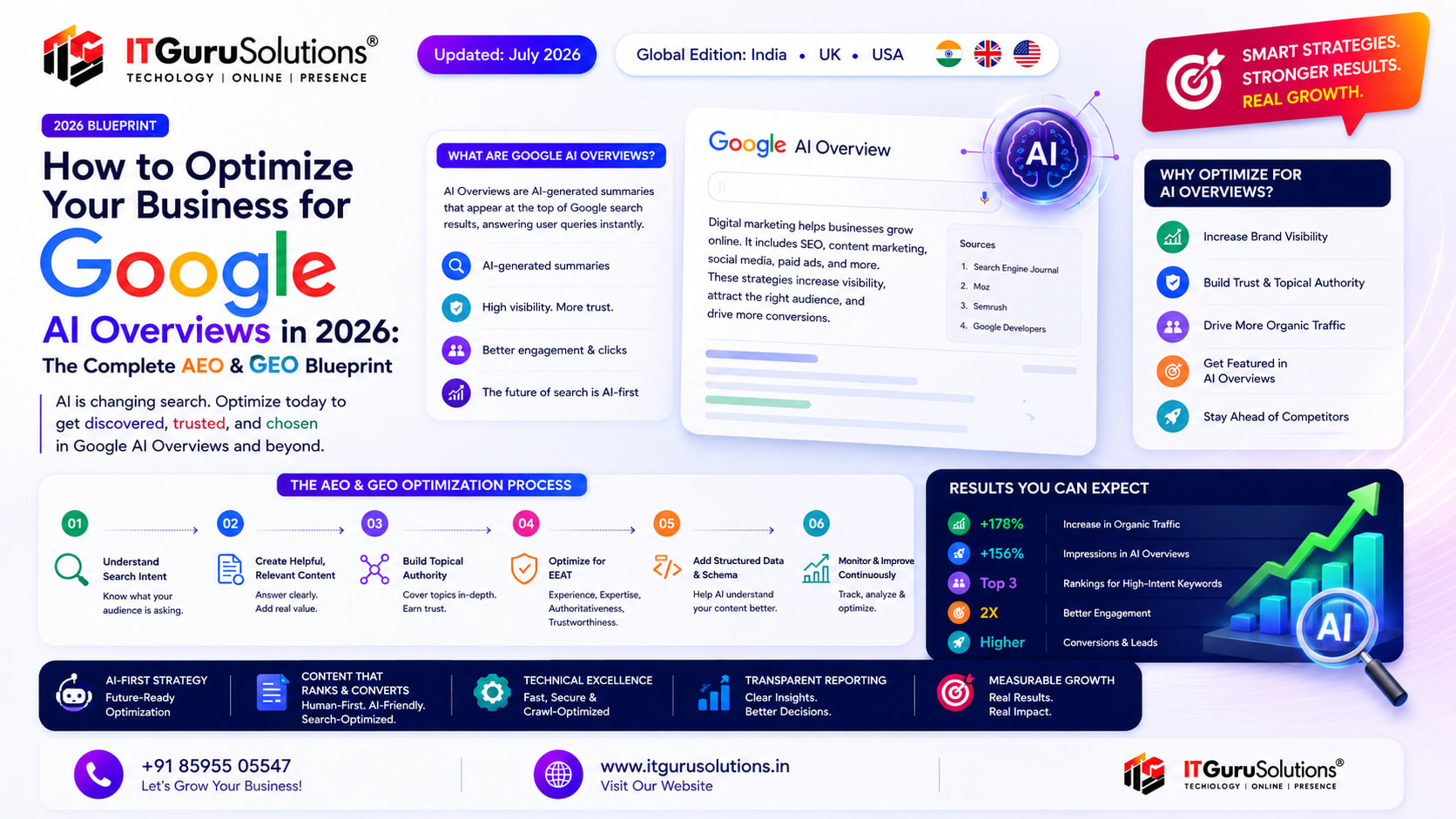
What Are Google AI Overviews?
Google AI Overviews are AI-generated summaries that appear within Google Search for eligible queries. They combine information from multiple web sources to help users understand a topic without requiring them to visit several pages.
This means a business can potentially appear as a cited source even when its page is not the traditional number-one result.
AI search therefore creates a second visibility opportunity beyond conventional rankings.
For example, a page about technical SEO, SEO services, or web development may be selected because it provides a particularly useful explanation of a specific question within a broader search topic.
The important distinction is this:
Traditional SEO focuses on visibility in search rankings. AEO and GEO focus on making your content useful and citable within AI-generated answers.
Google AI Mode is a separate conversational search experience. It can explore related queries and combine information from different sources before producing a response. This makes comprehensive, logically structured content increasingly valuable.
Traditional SEO vs AEO vs GEO
Traditional SEO, Answer Engine Optimization, and Generative Engine Optimization work together rather than replacing one another.
| Aspect | Traditional SEO | AEO | GEO |
|---|---|---|---|
| Primary goal | Rankings and organic traffic | Become a useful answer source | Become a trusted AI-referenced source |
| Content structure | Keyword and topic focused | Direct-answer focused | Entity and context focused |
| Main signals | Relevance, links, technical SEO | Clear answers and structure | Authority, originality and factual depth |
| Important content | Landing pages, blogs and guides | FAQs and answer sections | Expert-led authoritative content |
| Measurement | Rankings, impressions and clicks | AI visibility and citations | Brand mentions and AI references |
Strong SEO services remain the foundation. AEO and GEO build an additional layer on top of that foundation.
For businesses that need a complete search strategy, technical SEO, content, authority, structured data, internal linking, and AI-search optimisation should work together rather than as separate activities.
What Is Answer Engine Optimization?
Answer Engine Optimization (AEO) is the process of structuring and improving content so search engines and answer engines can understand specific questions and extract useful answers from your website.
Instead of asking only:
"What keyword should this page rank for?"
AEO asks:
"What question is the user asking, and can this page provide the clearest answer?"
That changes how content should be written.
A strong AEO page should generally:
- Identify the user's search intent.
- Answer important questions directly.
- Explain the answer with supporting context.
- Use descriptive headings.
- Provide accurate and verifiable information.
- Connect related concepts through internal links.
- Make important information accessible in crawlable HTML.
- Demonstrate expertise and trustworthy authorship.
What Is Generative Engine Optimization?
Generative Engine Optimization (GEO) focuses on improving the likelihood that your content will be understood, referenced, or surfaced by generative AI systems.
This extends beyond Google Search.
Businesses increasingly need to consider AI-driven discovery across platforms such as Google, ChatGPT, Perplexity, and Microsoft Copilot.
GEO is particularly valuable when your content contains information that demonstrates genuine expertise rather than generic statements that hundreds of other websites could produce.
For an IT services company, for example, a useful article about SEO, web development, AI search, or digital marketing should demonstrate real technical understanding, practical examples, clear definitions, and relevant business context.
Generic content is easy for AI systems to replace.
Specific expertise is much harder to replace.
Why Content Quality Comes Before Schema
One of the biggest mistakes businesses make with AEO is treating structured data as the entire strategy.
Schema is useful, but it cannot compensate for weak content.
Before adding or expanding schema, review your existing pages and ask:
Does this page genuinely answer the questions my prospective customers are asking?
Many service pages focus almost entirely on the company:
- "We provide SEO services."
- "We provide web development."
- "We provide digital marketing."
That information is useful, but it does not fully satisfy the user's research intent.
A stronger page explains:
- What is the problem?
- Why does it happen?
- What should the business do?
- What are the available solutions?
- What should the buyer consider?
- When should professional help be used?
Your expertise should appear naturally throughout those explanations.
How to Structure Content for AI Search
AI systems need to understand both the overall topic and individual passages within a page.
Start With the Direct Answer
For important questions, provide the answer immediately. Do not force users or search systems to read several paragraphs before discovering the main point.
Explain the Reason
After the direct answer, explain why it is correct and provide relevant context.
Add Practical Detail
Where appropriate, include implementation steps, examples, comparisons, limitations, and decision criteria.
Use Question-Based Headings
Instead of forcing keywords into headings, use headings that reflect genuine user questions.
For example:
How does AEO differ from traditional SEO?
is more useful than:
Best AEO SEO Services Company for SEO Optimization
The first heading communicates meaning naturally. The second looks artificially optimised.
Keep Paragraphs Focused
Short paragraphs with one clear idea are easier to scan for both users and search systems.
Entity SEO and Why It Matters
AI search depends heavily on understanding relationships between entities.
Your organisation name, services, people, locations, and supporting information should be consistent across your digital presence.
For example, IT Guru Solutions should have consistent organisation information across its website and relevant external profiles.
Your content should also clearly connect:
IT Guru Solutions → SEO Services → Technical SEO → AEO → GEO → AI Search
This creates a stronger topical and entity relationship than publishing unrelated articles around isolated keywords.
Named authors can also strengthen content credibility when their expertise is clearly presented.
Where appropriate, structured data can help communicate relationships between your Organisation, Person, Service, and other relevant entities.
Technical SEO Still Controls AI Search Accessibility
A page cannot become a useful AI source if search engines cannot properly access, understand, or index it.
Technical SEO therefore remains essential.
- Robots.txt: Do not unintentionally block valuable content.
- XML sitemaps: Include important indexable URLs.
- Canonical tags: Identify the preferred version of each page.
- Internal links: Help crawlers discover related content.
- Core Web Vitals: Monitor real-user performance data where available.
- Crawlable HTML: Keep important information accessible without relying entirely on client-side rendering.
This is why AEO and GEO should not be treated as replacements for technical SEO. They are extensions of a healthy search architecture.
Internal Linking Builds Topical Authority
Internal linking is one of the most practical ways to connect educational content with your commercial service architecture.
For example, an article about AI search can naturally introduce readers to SEO services when discussing technical SEO, content optimisation, entity signals, and AI visibility.
Discussions about acquisition and online growth can naturally connect to digital marketing services , while technical implementation topics can reference web development services .
Content production and optimisation topics can also point readers toward SEO content writing services when relevant.
The objective is not to add links simply because they exist.
Every internal link should answer a natural question:
What should the reader explore next?
A strong internal-link structure might look like:
AI Search Article → SEO Services → Technical SEO Content → Web Development Services → SEO Content Writing Services
This helps users discover relevant information while reinforcing relationships between your content and commercial pages.
What Should Service Businesses Prioritise in 2026?
1. Improve Answer Quality
Audit existing content and identify pages that describe services without answering customer questions. Rewrite them around search intent and decision-making needs.
2. Build Clear Expertise Signals
Use real authors, relevant experience, transparent business information, and specific examples. Avoid vague claims that cannot be substantiated.
3. Strengthen Technical SEO
Fix crawlability, indexation, canonicalisation, structured data, Core Web Vitals, and internal-linking issues.
4. Build Topic Clusters
Instead of publishing dozens of unrelated articles, create connected content around your core commercial topics.
For example:
SEO Services → Technical SEO → Local SEO → AI SEO → AEO → GEO → Semantic SEO → Internal Linking → Structured Data → SEO Audits
This creates stronger topical depth than publishing isolated keyword-targeted articles.
5. Create Original, Useful Information
AI can generate generic explanations very easily.
Your competitive advantage is information based on actual expertise, research, implementation experience, original analysis, and specific business contexts.
Frequently Asked Questions About AEO and AI Search
Does my website need to rank number one to appear in Google AI Overviews?
Not necessarily. AI-generated search features can use information from multiple sources. A page that provides a particularly clear and relevant answer to a specific part of a query may still become useful as a source even when it is not the traditional first result.
Should I add Speakable schema to every page?
No. Speakable structured data has specific use cases and should not be treated as a universal requirement for every business page. Service businesses should prioritise relevant structured data such as Organisation, Service, BreadcrumbList, and FAQPage where the content genuinely qualifies.
How much content do I need for AI Search?
Content volume is less important than content quality and topical coverage.
One comprehensive, authoritative resource can provide more value than several thin articles targeting slightly different versions of the same keyword.
Focus on answering the complete search intent rather than producing content simply to increase publishing frequency.
How often should SEO and AEO content be updated?
Review evergreen content when important developments occur and periodically check it for outdated information.
When you make substantial changes, update the visible date where appropriate and make sure the revised content genuinely improves accuracy, usefulness, or depth.
The Future of SEO Is Search Visibility Plus Answer Visibility
Google AI Overviews and other generative search experiences are changing how people discover information, but they do not eliminate traditional SEO.
They make strong SEO more important.
A technically healthy website provides the foundation. High-quality content provides relevance. Internal linking establishes topical relationships. Structured data helps communicate entities and page meaning. E-E-A-T signals support credibility. AEO makes important answers easier to identify. GEO extends that thinking to generative search environments.
The strongest strategy is therefore not:
SEO vs AEO vs GEO
It is:
Technical SEO + Search Intent + Topical Authority + Entity SEO + AEO + GEO
For businesses that want to improve visibility across traditional search and emerging AI search experiences, IT Guru Solutions combines technical SEO, content optimisation, and AI-search readiness as part of its broader SEO services .
You can also explore the full range of IT Guru Solutions services covering SEO, digital marketing, web development, content, design, and other digital solutions.
If you want to assess how well your website is prepared for traditional Google Search, AI Overviews, and generative search, start with a structured SEO and AEO readiness audit.
Key Takeaways
- What Are Google AI Overviews
- Traditional SEO vs AEO vs GEO
- What Is Answer Engine Optimization
- What Is Generative Engine Optimization
Frequently Asked Questions
- Does my website need to rank on page one to appear in AI Overviews?
- Not necessarily. Google AI Overviews draw from multiple sources. A page ranking lower but answering a specific subtopic clearly can still be cited.
- Should I add SpeakableSpecification schema to every page?
- Speakable schema is most relevant for news and media content. For service businesses, focus on Organisation, Service, FAQPage, BreadcrumbList, and LocalBusiness schema instead.
- How much content do I need to produce to be competitive in AI Search?
- Volume is less important than depth. One genuinely authoritative article is more valuable than ten thin articles on related terms.
About IT Guru SEO Team
IT Guru SEO Team contributes SEO insights for IT Guru Solutions, a Delhi NCR company founded in 2020 with Full-Stack Builds projects delivered and clients in Global Delivery countries.
Read Next
Comprehensive Analysis of Meta Keywords: Algorithmic Obsolescence, Enterprise CMS Architecture, and the Evolution of Semantic Search
Discover why enterprise brands leave meta keywords blank, how search algorithms deprecated legacy metadata, and what Schema.org and semantic SEO use today.
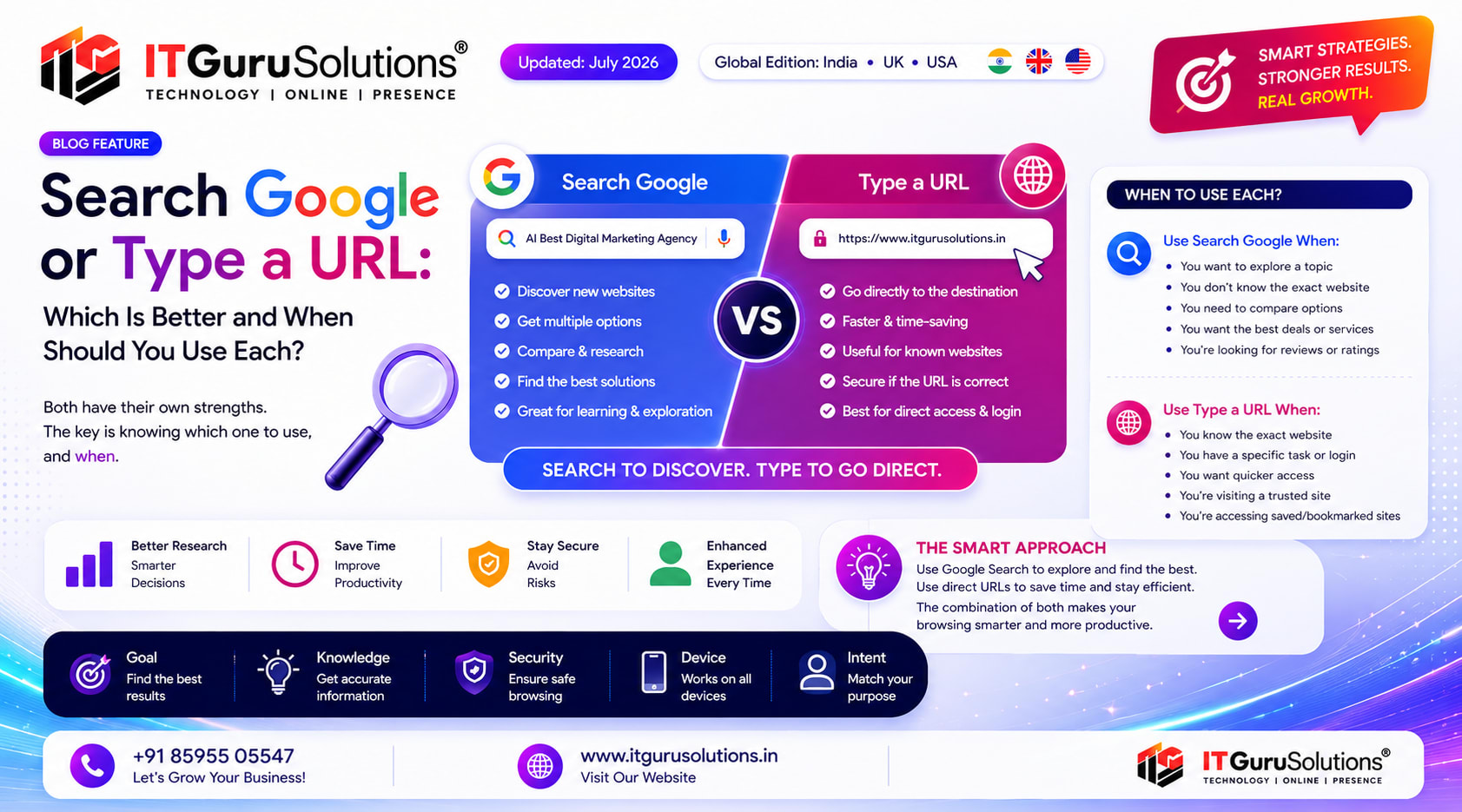
Search Google or Type a URL: Which Is Better and When Should You Use Each?
Confused whether to search Google or type a URL? Learn the real difference, when each method works best, and how to search smarter online.
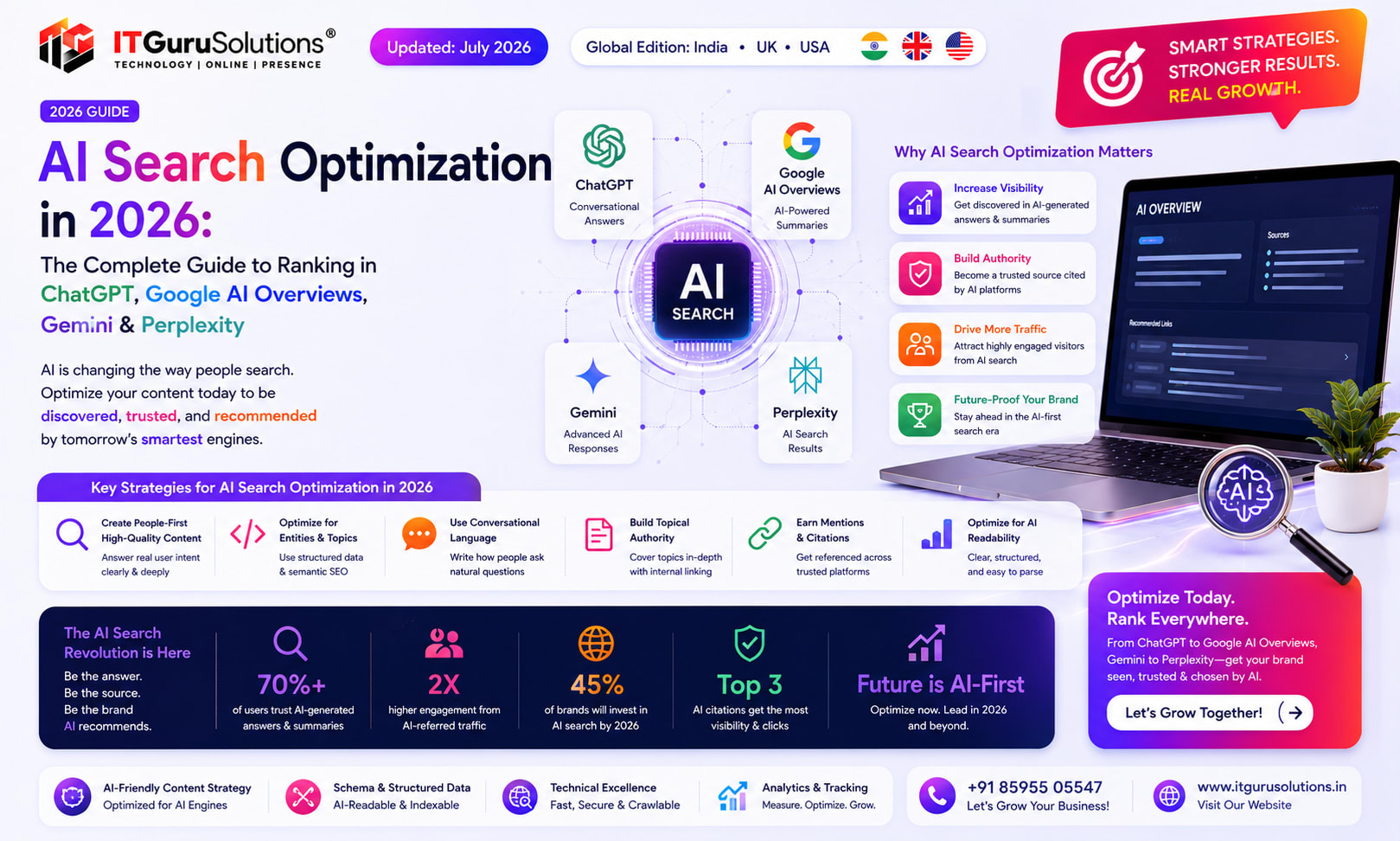
AI Search Optimization in 2026 : Complete Guide to ChatGPT, Google AI Overviews, Gemini & Perplexity
Learn AI Search Optimization with practical strategies for Google AI Overviews, ChatGPT, Gemini, AEO, GEO, Semantic SEO, and Entity SEO.
Continue Reading
View allPrevious
Search Google or Type a URL: Which Is Better and When Should You Use Each?
Confused whether to search Google or type a URL? Learn the real difference, when each method works best, and how to search smarter online.
Next
How Much Does Mobile App Development Cost in India in 2026? iOS, Android and React Native Pricing Guide
Mobile app development in India ranges from Rs 2.5 lakh for a simple utility to Rs 45 lakh plus for a full-featured marketplace. This pricing guide breaks down real costs for iOS, Android, and cross-platform builds.
Ready to implement these strategies?
Our team at IT Guru Solutions can help you achieve your goals with expert guidance.